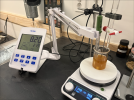
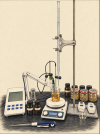
Han er en episode på Weissbier også - jeg er personlig overbevist om at vannkjemi og syrejustering er en av de manglende bitene av puslespillet som gjør at den stilen er vanskelig i praksis. Jeg har reagert på at mine noen ganger blir for tynne og syrlige mens mange av de man kjøper oppfattes som mer runde og fyldige. Selv om pH-målingen ikke er hele bildet var det interessant å måle Weihenstephaner Hefe Weissbier til 4.53 med ph2Go. Dersom man følger "vanlig" logikk på vannkalkulatorer på lys maltgrist for å få pH i mesk innenfor korrekt område så må man tilsette en del syre, men det gir nok ikke det sluttresultatet man vil ha er min foreløpige konklusjon.
Jeg er skeptisk til det der. pH er ikke så viktig når du brygger weissbier, fordi gjæren sørger for å regulere den, i alle fall om vi skal tru
weissbierartikkelen fra Braumagazin. Det er så et faktum som åpner opp for en del interessante manipulasjoner av andre forhold som har med pH å gjøre.
Her er det relevante avsnittet:
4.2 Brewing water considerations
Wheat beers tolerate a relatively large range in water profiles. Generally, residual alkalinities up to 10°dH are of no concern. The resulting higher mash pH should however be taken into account during the brewing process. The reasons for high tolerance of water profiles are:
- Wheat beer yeasts generate a high pH drop during the fermentation resulting in a satisfactory beer pH even if the wort pH was unfavorable high.
- Since wheat does not have husks the increased solution of polyphenols caused by a high mash pH is restricted to the barley.
- Due to the style typical low hopping the increased hop utilization with increased pH, especially of less desirable compounds, does not create significant problems.
- The higher cloudiness and reduced brightness as a result of higher pH is tolerable for this beer style. Higher turbidity of the post boil wort results however in lower contents of esters in the beer.
High salt contents can reduce the desired soft taste of the beer. Therefore, it is advisable to desalinate the water rather than using brewing salts to increase the mineral content. Considering the aforementioned reasons, a mash or wort acidification is normally not carried out. It has been observed that an acidified mash results in lower quality estery aromas [Her05]. Wort acidification 10 minutes before the end of boil can increase the phenolic and fresh character of the beer, according to Drexler (Weißbierbrauerei Schneider-Weisse).
Even though the brewing process tolerates a large range of residual alkalinities they should be taken into account. Possibilities to counteract the high residual alkalinities without water treatment are:
- Dark malts, cara malt
- Low hop additions
- High percentage of wheat malts
- Healthy, active yeast for a sufficient pH drop
With increased wort pH several chemical reactions including the Maillard reactions are enhanced. Maillard reactions can create nutty, bread like flavors as well as adding significant coloration. This fact can be exploited to create an individual and characteristic Weissbier style simply by adjusting the boiling times and without resorting to darker malts. Since the conversion and evaporation of DMS (corn flavor) is increased for higher wort pH’s a 60-minute boil is normally sufficient. For a nuttier flavor some commercial breweries use boil times of 2 hours and more. In summary the water can be moderately adjusted, the brewing process can be adjusted to the water or a structured yet chaotic approach can be used and as such the water “challenge” offers sufficient scope for individual variation.




 ?